
No-Till in the High Tunnel: What Our Two-Year Soil Health Study Revealed
By Beth Portesi, Lazy Acres Farm | January 2026
When we first applied for a SARE (Sustainable Agriculture Research and Education) Western Farmer/Rancher Grant in 2023, we had a simple question: Can no-till practices help maintain soil health in high tunnel production?
High tunnels are incredible tools for season extension, but the intensive production they enable can take a toll on soil biology. We'd read about the "desert effect" in high tunnels—soil degradation from constant cultivation, lack of rain, and the use of plastic mulch. We wanted to know if no-till practices could be part of the solution.
What we discovered surprised us in ways we didn't expect.
The Setup: Building Our Experiment
Our research compared three growing environments:
A 30' x 100' high tunnel we constructed specifically for this project
Low tunnels (outdoor beds covered with floating row cover on hoops)
Outdoor control beds with no protection
Within each environment, we established paired beds to test another common practice: plastic mulch versus no mulch. All beds received identical inputs—same compost, same organic 4-4-4 fertilizer, same Salanova lettuce varieties, same drip irrigation.
We submitted soil samples to Oregon State University's Soil Health Laboratory at three points:
April 2024 (baseline)
July 2025 (mid-season)
October 2025 (final)
Spring 2025: The Growing Season Begins
By late March 2025, our high tunnel construction was complete. Building on a 7% slope had required modifications to every ground post and hoop, but the result was a functional growing space that would allow us to collect meaningful data.

March 29, 2025: Our completed high tunnel, with beds prepared and the remnants of winter cover crop visible.
The first week of April, we began transplanting. Our no-mulch beds featured bare soil amended with compost, with drip irrigation lines running between the rows.

April 1, 2025: Fresh transplants in the no-mulch beds. You can see the rich, dark soil we'd been building with no-till practices—compost applied on top, never tilled in.
Late April: Growth Takes Off
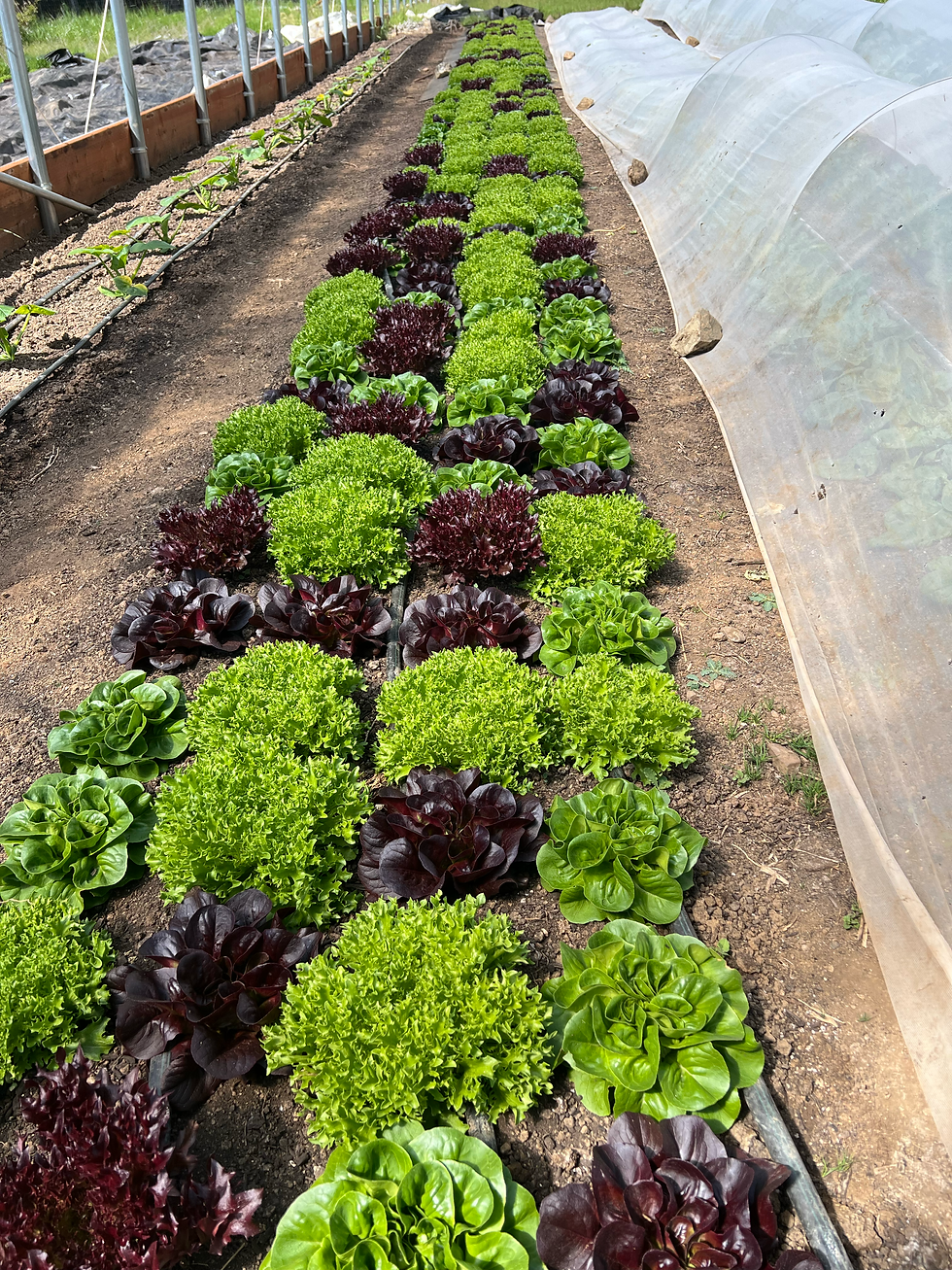
April 22, 2025: The no-mulch beds were flourishing. Multiple Salanova varieties—green oakleaf, red oakleaf, butter lettuce—growing in direct contact with the soil surface.
May: Peak Production
By early May, we were in full harvest mode. The lettuce had reached market size and we were tracking yields carefully.

May 9, 2025: Peak production in the no-mulch beds. The variety of colors and textures made for beautiful market displays—and the yields were exceeding our expectations.
The Mid-Season Soil Check: A Concerning Signal
When we got our July 2025 soil results back, something jumped out immediately.
Microbial biomass had crashed.
Our baseline reading of 4,687 µg/g had dropped to just 814 µg/g in the high tunnel—an 83% decline. The outdoor beds showed a similar pattern, dropping from 4,368 to 803 µg/g.
This was concerning. Microbial biomass is the living component of soil—the bacteria, fungi, and other organisms that drive nutrient cycling and soil health. Were we doing something wrong?
We continued the trial, hoping the fall soil tests would provide more answers.
September: Late Season Observations
By late September, we were documenting our final succession plantings. The mulched beds showed the wear of a full growing season.

September 25, 2025: Late-season lettuce in the plastic mulch beds.
The Results: What the Numbers Tell Us
The Good News: Organic Matter Built Dramatically
Despite the microbial biomass concerns, our no-till practices delivered on one key promise: building soil organic matter.
Indicator | Location | April 2024 | October 2025 | Change |
Organic Matter (%) | High Tunnel | 6.52 | 10.04 | +54.0% |
Organic Matter (%) | Outdoor | 6.78 | 10.46 | +54.3% |
Active Carbon (ppm) | High Tunnel | 693 | 893 | +28.9% |
Cation Exchange Capacity | Both | 28 | 39 | +39.3% |
Over 50% increase in organic matter in just one growing season. This suggests our no-till approach—terminating cover crops by cutting rather than tilling, applying compost on the surface, maintaining soil structure—was effectively building long-term soil carbon.
The Concerning News: Microbial Communities Struggled
Indicator | Location | April 2024 | October 2025 | Change |
Microbial Biomass (µg/g) | High Tunnel | 4,687 | 1,604 | -65.8% |
Microbial Biomass (µg/g) | Outdoor | 4,368 | 1,537 | -64.8% |
Even with partial recovery from the July low point (814 µg/g), microbial biomass remained well below baseline. This suggests that intensive lettuce production—even with no-till practices—stresses soil microbial communities.
The mid-season crash likely reflects the constant harvest pressure and lack of living roots between successions. Microbes need food, and monoculture lettuce production may not provide enough diversity to sustain them.
The Structural Story: High Tunnels Protected Soil Aggregates
One of the most striking findings involved water stable aggregates—a measure of soil structure integrity.
Location | April 2024 | October 2025 | Change |
High Tunnel | 50% | 49% | -2.0% |
Outdoor | 55% | 35% | -36.4% |
The high tunnel environment maintained soil structure almost perfectly, while outdoor beds lost over a third of their aggregate stability. This suggests that high tunnels may help protect soil physical properties from degradation, even under intensive production.
The Surprise Finding: Plastic Mulch Reduced Yields
Perhaps our most unexpected result came from the harvest data.
Treatment | No Mulch | With Mulch | Difference |
High Tunnel | 36.5 lbs | 30.4 lbs | No mulch +20.1% |
Outdoor | 36.2 lbs | 34.3 lbs | No mulch +5.5% |
Beds without plastic mulch outperformed mulched beds in both environments.
The effect was especially pronounced in the high tunnel, where no-mulch beds produced over 20% more lettuce. This contradicts the common assumption that plastic mulch benefits production through weed suppression and moisture retention.
Our hypothesis: the combination of protected cultivation (high tunnel) plus plastic mulch creates a "double barrier" effect that may be harmful to soil biology and, consequently, plant performance. The no-mulch beds maintained direct soil-plant-atmosphere contact, potentially supporting better nutrient cycling and root function.
What We Learned
No-till builds organic matter—even in intensive production
A 54% increase in organic matter over one season demonstrates that surface application of compost and cover crop residues effectively builds soil carbon without tillage.
High tunnels protect soil structure
The dramatic difference in water stable aggregates (2% loss in tunnel vs. 36% loss outdoors) suggests high tunnels buffer soils from some forms of degradation.
Intensive production stresses microbial communities
Even with no-till practices, continuous lettuce production reduced microbial biomass significantly. Future seasons should incorporate more cover cropping and rest periods.
Reconsider plastic mulch—especially in high tunnels
Our data suggests plastic mulch may actually reduce yields in protected cultivation environments. The mechanisms deserve further study, but farmers should evaluate whether mulch is truly necessary.
One year isn't enough
This research represents a single growing season. We don't yet know if microbial communities will recover, if organic matter gains will persist, or how these trends play out over time. Continued monitoring would be valuable.
Recommendations for Farmers
Based on our experience, here's what we'd suggest for small-scale growers interested in no-till season extension:
Commit to no-till for the long term. The organic matter and carbon benefits are real, even if microbial responses are complex.
Question the need for plastic mulch. Our yields were better without it. At minimum, run your own comparison trials.
Build in rest periods. Consider cover cropping between lettuce successions, even if just for a few weeks, to feed soil biology.
Monitor water stable aggregates. This metric showed the clearest difference between protected and unprotected cultivation.
Test your soil over multiple years. Single-year results can be misleading. Trends matter more than snapshots.
Acknowledgments
This research was funded by a SARE Western Farmer/Rancher Grant (FW23-425). We're grateful to Maud Powell for technical guidance and to the Oregon State University Soil Health Laboratory for their thorough analysis.
For questions about this research, contact us at info@lazyacresfarm.org.
Comments